Even and Odd Numbers in English for Kids
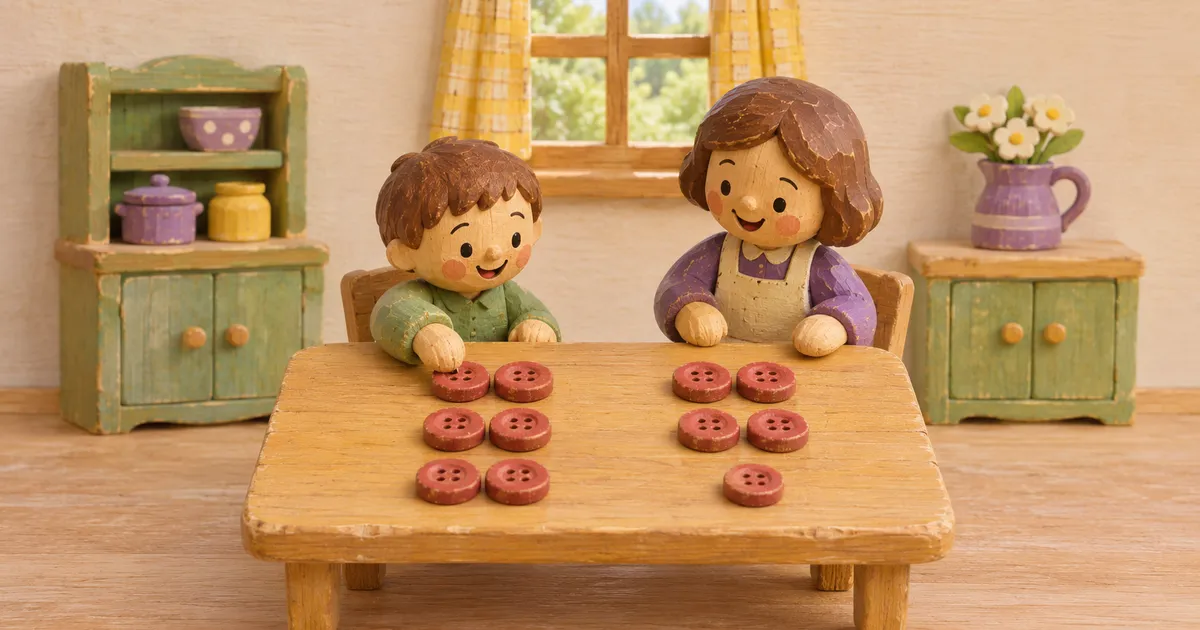
An even number splits into two equal groups with nothing remaining; an odd number leaves one item without a partner. Even and Odd Numbers in English for Kids: Words and Activities teaches children to describe and test this rule with objects. Younger learners can pair buttons, blocks, beans, or shells. Older children can classify larger numbers by their final digit. Your child should recognize the pattern, pronounce the number words, and explain each answer.
📥 Even or Odd? Number Detective Practice
Read, sort, match, and correct number sentences in English.
Leave your email — we'll send the PDF to your inbox.No spam — the PDF plus one short reminder. Unsubscribe anytime.
Core Words and Phrases
Start with number words from zero to twelve: zero, one, two, three, four, five, six, seven, eight, nine, ten, eleven, and twelve. Then introduce even, odd, pair, equal groups, and left over. This vocabulary helps your child explain the rule instead of guessing.
The phrase set in Even and Odd Numbers in English for Kids: Words and Activities should include complete frames: “Six is an even number,” “Nine is an odd number,” “We can make four pairs,” and “There is one left over.” Ask your child to repeat each sentence after checking it with objects or a drawing.
Use an before singular phrases: “an even number” and “an odd number.” With plurals, say “even numbers” or “odd numbers.” Ask, “Is fifteen even or odd?” Your child can answer, “Fifteen is odd.”
How the Rule Appears in English Sentences
Begin with visible sets. Put five spoons on a table and move them into pairs. Say, “Two pairs and one spoon remains unpaired. Five is odd.” With eight toy animals, make two groups of four: “Both groups are equal. Eight is even.” Each action gives the English phrase a concrete meaning.
Next, introduce the final-digit rule. A whole number is even when its last digit is 0, 2, 4, 6, or 8. It is odd when its last digit is 1, 3, 5, 7, or 9. Your child need not divide 246 into groups; the final digit, six, proves it is even.
Vary the questions without changing the rule: “Can every counter find a partner?”, “Can we share these equally between two plates?”, or “Will one remain unpaired?” The wording connects pairing, sharing equally, and even or odd.
Quick pairing tip Let your child move each object while saying “one pair.” Touching and naming each pair slows the task and reveals missed objects.
Activities for Different Ages
For school-age kids, use visible sets of one to ten objects. Ask your child to match partners, draw two equal groups, or arrange two lines. Ask: “Does any object remain unmatched?” and “Even or odd?” Complete five or six rounds.
Turn Even and Odd Numbers in English for Kids: Words and Activities into a sorting task. Write number cards from 0 to 30 and label two spaces even and odd. Your child sorts each card and explains one choice in a full sentence. Add larger numbers once the final-digit rule feels familiar.
Set reasoning challenges with 317, 2,508, and 91,024. Require an even-or-odd answer and an English reason. Learners can test sums: odd plus odd gives an even number; even plus odd gives an odd number. Focus on the pattern and explanation.
Before ending a practice round
- Ask your child to sort at least six numbers.
- Check that each choice includes a spoken reason.
- Include zero in one round.
- Mix small numbers with one or two larger numbers.
- Correct the English sentence after the child finishes the reasoning.
Short Practice Ideas for Home

Count socks before pairing them, share grapes between two bowls, or count steps between rooms. Ask your child to predict, test the set, and state the result. This three-part routine practises number words, classification, and reasoning.
A number hunt turns Even and Odd Numbers in English for Kids: Words and Activities into a five-minute routine. Find numbers on clocks, book pages, buses, doors, or food packets. Your child names and classifies each number. Do not rely on colour; the spoken number and reason provide the core language practice.
Multilingual children may know the concept in another language. Let them demonstrate the rule, then supply the English words. Do not reteach the entire concept. Compare number names when needed: the English label changes, but the pairing rule remains.
Try a Ten-number Challenge
Choose ten numbers between 0 and 50. Your child says each number, labels it even or odd, and explains two answers with “because.” For an extra round, ask your child to change each number into the other type by adding one.
Common Mistakes and How to Correct Them
Some children assume a large number must be even or an unfamiliar number must be odd. Return to pairs. Twelve is even because it makes six pairs; thirteen is odd because one remains. Then classify larger numbers by their final digit.
Zero can cause confusion. Zero is even because dividing it into two equal groups of zero leaves no remainder. Show two empty plates: “Both plates have the same number. Nothing is left over.” The example is simple, but precise wording matters.
English creates another trap: even can mean flat, equal, or calm. Keep early examples tied to numbers: “Four is even.” Correct “Four is an even” to “Four is an even number.” For pronunciation, contrast the short word odd with the two-syllable word even.
Two direct corrections
Myth: A number is odd when it is hard to divide.
Fact: A whole number is odd when dividing it into two equal groups leaves one.
Myth: Zero is neither even nor odd.
Fact: Zero is even because sharing zero into two groups leaves no remainder.
- Ask your child to sort numbers 1 through 20 into two groups.
- Check each even number by pairing counters with no extras.
- Correct odd-number mistakes by showing the single counter without a partner.
- Read number words aloud, then match each word to its numeral.
- Repeat the sorting game using page numbers from a favorite book.
When a word has several meanings or pronunciations, Cambridge Dictionary is a useful check before turning it into child-friendly examples.
Frequently Asked Questions
When Should a Child Learn Even and Odd Numbers?
Children can explore the idea once they can count a small set and make pairs, often during play. Start with two to ten objects and the phrases “make pairs” and “one left over.” Introduce written numbers after your child can explain what happened to the objects. Older learners can start with the final-digit rule, then confirm it through pairing.
Is Zero an Even Number?
Yes. Zero is even because it divides by two without a remainder. In Even and Odd Numbers in English for Kids: Words and Activities, two empty groups model the rule: each contains zero objects, both are equal, and nothing remains. Zero may seem unusual after practice with visible objects, but it follows the same rule as two, four, and six.
Why Does My Child Keep Mixing up Even and Odd?
Your child may remember the labels without understanding the test or know the rule without the English vocabulary. Use objects, make pairs, and ask what remains. Then add the label: nothing remaining means even; one extra item means odd. Practise question and answer forms. Short sessions with specific reasons strengthen understanding more than memorising a long list.
Can a Multilingual Child Learn This Topic in English First?
Yes, but English need not be the only starting language. If your child understands pairing in another language, connect that knowledge to even, odd, pair, and left over. If the concept is new in every language, demonstrate it with objects before requesting an English explanation. Accept a mixed-language answer first, then model one complete English sentence.
Finish with a three-step check: ask your child to sort six numbers, explain two choices with “because,” and correct one English sentence. Repeat this five-minute routine twice during the week.
Want to see how these ideas work in a real lesson — try a LearnLink trial lesson.
Stay updated on our latest tips and resources by following us on Instagram LearnLink.